The Public Relations Office
of HRH Crown Prince Alexander
Touristic Guidepost, May 2011
The Royal Compound in Dedinje is opened for visitors
THE GLORY OF THE SERBIAN ROYAL PALACE
The Royal Compound, located on the top of Dedinje’s Hill, is surrounded by dense
forest, extends to 134 hectares of beautifully arranged parks, which is the
masterpiece of French architect Eduard Andre.
In London the unavoidable touristic destination is Buckingham
Palace, in Paris you must see the Chateau de Versailles, and in Belgrade that
would certainly be the Royal Compound in Dedinje. The interesting history of its
occupants, from HM King Alexander, General Ler and Josip Broz, Crown Prince
Alexander Karageorgevitch; numerous valuable pieces of art as well as the beauty
of ambience…are the crucial reasons which led to the decision of Crown Prince
Alexander to open the Royal Compound for visitors, in cooperation with the
Belgrade Tourist Organization.
The Royal Compound is located at the top of Dedinje Hill,
surrounded by dense forest, extends to 134 hectares of beautifully arranged
parks, which is the masterpiece of French architect Eduard Andre. Construction
began under HM King Alexander’s I Karageorgevitch and it lasted from 1924, when
building of the Royal Palace started, until 1936, when construction of the White
Palace ended.
THE ROYAL PALACE
Most of Belgrade citizens, while passing by the Rakovica road or through
Kosutnjak forest, think that the huge white house they see on the top of the
hill is the White Palace. But the building people see is actually the Royal
Palace. It was built from 1924-1929 designed in Serbian-Byzantine style. The
facade is made of white marble from Brac Island, and the whiteness of the
building is the reason why people think this is the White Palace. The Palace is
surrounded with pergolas, park galleries, pools, pavilions and a concert
balcony.
When entering the Royal Palace one feels like entering into
the world of culture and art. In all rooms and on the walls there are paintings
and tapestries of huge art value. On the ground floor the is located a great
dining room, library with numerous and very rare books; the Blue Salon which is
modeled like old French salons from the 18th Century and which leads to spacious
balcony; the Golden Salon where there are paintings of famous Italian masters.
This room is the place where people can see glamorous shrines, a wedding present
to HM King Alexander and HM Queen Maria.
The private chambers of the Royal Family are located on the
first floor. The basement of the Royal Palace is a special story. While going
down the marble stairs one feels like entering into the world of fairytales. All
ceilings and walls are painted with themes from ember-bird fairytales. The
central room, which leads to other rooms, is in orange and red shades. On the
left side is the Room of Whispers, which served for confidential conversations
for occupants. For complete discretion, with no chance of wiretapping, the
occupants turned on the fountain, so the murmur of the water would quell their
voices.
Today’s Billiard room used to be a wine cellar, where the
Royals kept their most precious wines from all over the world. Among them, there
was a separate special place for wines from Oplenac and King’s vineyards. On the
ceiling visitors can see hand whitened verses of the old Serbian national poem
“The wedding of the Emperor Dusan”. The most interesting room in the basement is
certainly the Cinema room, which is painted in green shades. When this room was
built, behind the cinema screen there was a piano which played music during the
film, because only silent films were played back in those days. Near this room
there is a small Club salon with four chairs, which served for playing cards and
casual entertainment.
THE ROYAL CHAPEL
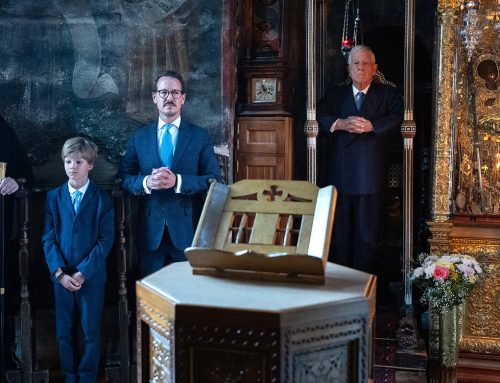
Nearby, attached to the Royal Palace with a colonnaded walkway, there is the
Royal Chapel, dedicated to Saint Andrew The First-Called , patron saint of the
Royal Family and the first Apostle of Jesus Christ. The Chapel was built in the
style of the Church of Saint Andrew, a prominent monastery on the River Treska
in Macedonia, 1389. It is painted with copies of the most powerful and beautiful
frescos from the Serbian monasteries. During the communist regime frescos and
iconostas were damaged.
According to communist ideology, the Royal Chapel served like a gardener’s
warehouse, but when some of the representatives of foreign diplomatic corps came
to visit, The Chapel was presented in its original form and purpose. Among the
most famous visitors were His Eminence Archbishop Makarios, Emperor Haile
Selassie and many others.
THE FOOD COMES THROUGH AN UNDERGROUND TUNNEL
Next to the Royal Palace is a building that served as The Royal Kitchen and the
place where servants lived. The food for Royal Family and their guests was
preparing there and then it was transferring to The Royal Palace trough a
tunnel, 83 meters long. This was because HM King Alexander did not like the
smell cooking in the palace.
THE WHITE PALACE
The White Palace was under reconstruction for two years (1934 -1936). First of
all, it was supposed to be a residence for Crown Prince Peter (future King Peter
II and father of Crown Prince Alexander), Prince Tomislav and Prince Andrej, but
after the assassination of King Alexander in Marseilles, it became the official
residence on loan of Prince Paul’s family. The building was designed in classic
style by architect Aleksandar Djordjevic. The lobby, with a large ceremonial
hall, several reception rooms, a library and formal dining room were primarily
used for large receptions and visits of foreign royalty and statesmen. On the
first floor there are five large apartments for guests.
The building became known due to the former Presidents Josip Broz Tito and
Slobodan Milosevic. In this building Tito received all the world’s greatest
statesmen, and during the Milosevic era it was remembered by a sofa where all
those who negotiated the fate of Serbia were seated. The “White Palace” is the
name accepted among people initially referring to the entire Royal Compound, and
just after the Royal Compound was opened to the public, it became known that the
name refers to the youngest of the buildings within the complex.
ART COLLECTION
Once you step inside the Royal Compound, you will see everywhere numerous pieces
of art and literature, all of inestimable value. Time and tempestuous historical
events have taken their toll, so that a great part of the art collection and
books is missing. However, the ones that have been stored and saved tell a story
about culture, education and wealth of the Royal Family who was committed to
collecting this treasure. There are many works of art from painters, sculptors
and applied artists such as: Jacopo Palma il Vecchio, Simon Vu, Rembrandt, Andre
Alovagio, Biagio d’Antonio, Giuseppe Grassi, Augustin Pajou, Ivan Mestrovic,
Paja Jovanovic, Toma Rosandic, Frano Krsinic, Vlaho Bokovac…
KINDLY HOSTS
Recently, during a journalists’ tour, without notice, appeared Crown Prince
Alexander Karageorgevich. Cheerful Crown Prince tried to relax the atmosphere
among the surprised reporters with a casual direct conversation, but the mood
was significantly improved after the arrival of Crown Princess Katherine, who
made jokes about her husband and with her cheerful temperament, put a smile on
the faces of all those present.
Four sessions per week
Tours of The Royal and White Palaces are organized accompanied by professional
tourist guides, and during the two hours a pleasant walk they see the history,
art and culture of The Royal Compound.
The Royal Compound is open to the public every Saturday and
Sunday from 1 April to 31 October, with two regular tours, from 11am to 2pm.
Also, there is the possibility of organizing group visits during the week by
appointment. Ticket include transportation by bus from Nikola Pasic Square. Also
there is the possibility of organizing a exceptional visits by calling the
Office of Crown Prince Alexander II by calling +381 11 306 4014 or e-mail:
[email protected]. For information and reservations visitors can contact the
Tourist Information Center in Belgrade, Knez Mihailova Street 6, 11000 Belgrade;
or +381 11 328-18-59 and +381 11 262 92 53 (fax); Contact person: Andjelka
Vukovic, e-mail:
[email protected];
Schools, student organizations and associations of pensioners
interested in visiting The Royal Compound can be announced directly to the
Office of Crown Prince Alexander II on +381 11 306 4014 or e-mail:
[email protected];
The number of visitors is limited to 50 people per group.
1997 HRH CP Alexander
All Rights Reserved
[email protected]